Act four · The interior
Nature, literature, and the interior
West of Boston, Massachusetts turns inland to literary towns, river valleys, engineered reservoirs, and mountains. Concord, Amherst, the Connecticut River Valley, the Quabbin, and the Berkshires hold the state's writers, its drinking water, its highest ground, and a concentration of art institutions in former mill and country-estate buildings.
Concord and Walden Pond
Concord, northwest of Boston, was the working address of a tight literary circle in the mid-nineteenth century: Ralph Waldo Emerson, Henry David Thoreau, Nathaniel Hawthorne, and the Alcott family all lived and wrote in or near the town. The most durable single text from that group is Thoreau's Walden, drawn from the roughly two years he spent in a small cabin he built on the north shore of Walden Pond beginning in 1845, on land owned by Emerson.
The pond and its surrounding woods are now Walden Pond State Reservation, about 335 acres managed by the Massachusetts Department of Conservation and Recreation. The land passed into public ownership in 1922 as a gift to the Commonwealth, was managed by Middlesex County for decades, and came under state conservation management in 1975. The reservation is a National Historic Landmark and includes a replica of Thoreau's cabin near the site of the original.
The site carries a tension worth naming: it is both a recreation area where people swim and walk and a literary shrine that draws steady crowds, which has at times put pressure on the shoreline and the water the reservation is meant to protect. Visiting in shoulder seasons or early in the day is the practical response.
Amherst and the Connecticut River Valley
South and west, the Connecticut River cuts a wide agricultural valley through the center of the state. The valley towns include Amherst, Northampton, Hadley, Deerfield, and, downstream, the city of Springfield. This is also the academic core of western Massachusetts, anchored by a dense cluster of colleges around Amherst and Northampton.
Amherst is most associated with the poet Emily Dickinson. The Emily Dickinson Museum centers on the Homestead, the brick house on Main Street where she was born in 1830, where she spent most of her life, and where she wrote the bulk of her roughly 1,800 poems before her death in 1886. Most of that work was unpublished in her lifetime. The Homestead was designated a National Historic Landmark in 1963, and the museum, which also includes the neighboring house known as The Evergreens, operates under the ownership of Amherst College.
The valley's fertile floodplain made it some of the most productive farmland in New England, and that history sits on older ground: the river valley was long inhabited by Indigenous peoples, including Nipmuc and Pocumtuc communities, whose dispossession through war and settlement in the seventeenth and eighteenth centuries preceded the towns and farms now there.
The Quabbin and the mountains
East of the river valley lies the Quabbin Reservoir, one of the largest unfiltered drinking-water supplies in the United States and, with the Wachusett Reservoir and the Ware River, a source for the Massachusetts Water Resources Authority system that serves metropolitan Boston. The reservoir was created in the 1930s by damming the Swift River and flooding the valley behind it.
That construction erased four towns: Dana, Enfield, Greenwich, and Prescott were disincorporated, their residents relocated, and their valley submerged. The Quabbin is now a quiet, heavily protected landscape, and the displacement that made it remains part of how the region understands the place rather than a footnote.
Farther west, in the Berkshires, Mount Greylock rises to 3,491 feet, the highest point in Massachusetts, with a state reservation and an auto road and trails to the summit. The surrounding hills are the state's main upland recreation zone and the setting for the cluster of cultural institutions described below.
The Berkshires: art in mills and country houses
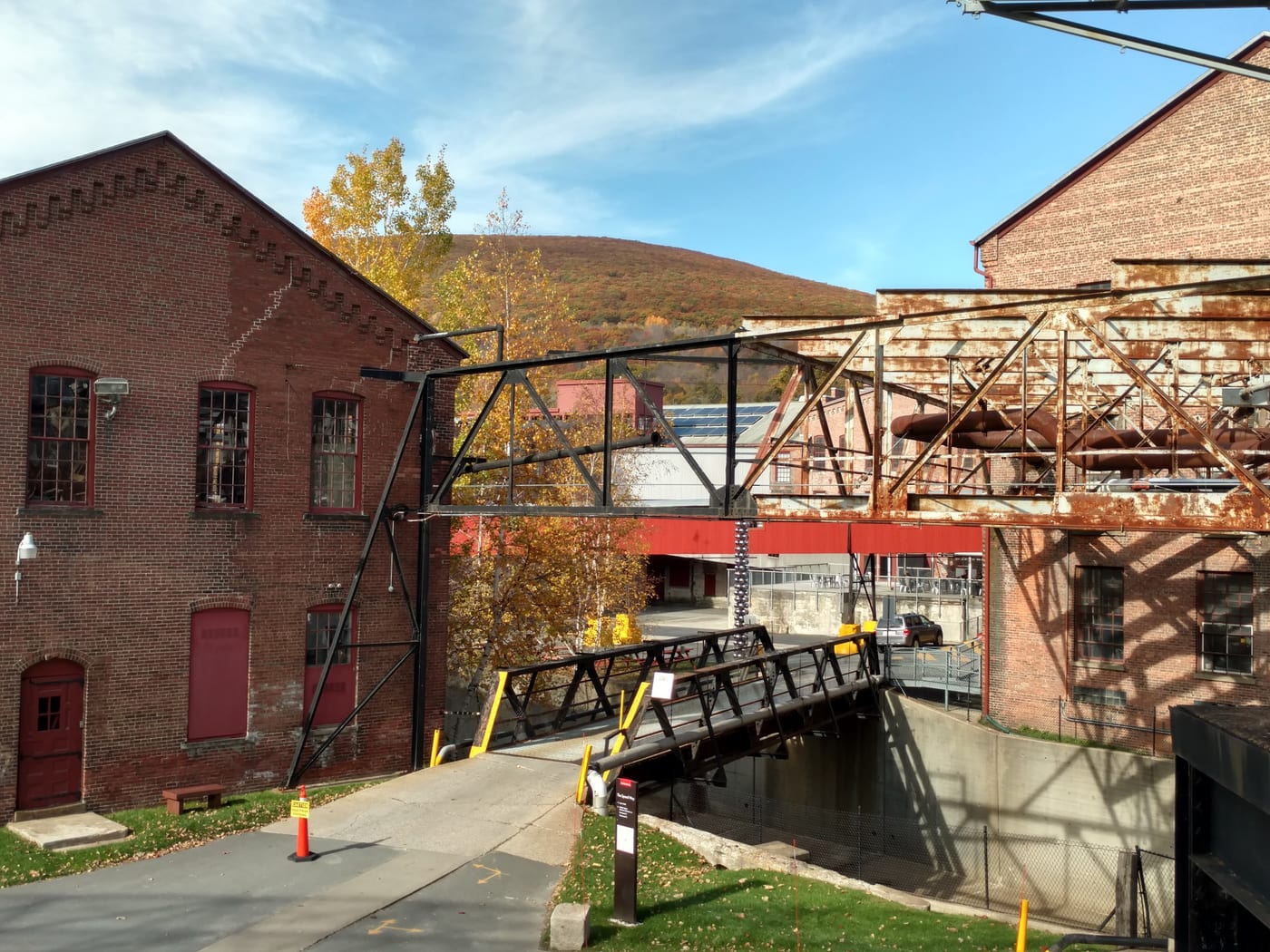
The Berkshires concentrate a set of art and music institutions, several housed in repurposed industrial or estate buildings. In North Adams, MASS MoCA occupies a large nineteenth-century mill complex that once held the Arnold Print Works and later the Sprague Electric Company; after Sprague closed, the site was converted and opened as a contemporary-art museum in 1999, with gallery and performance space spread across the campus.
In Williamstown, the Clark Art Institute, founded by the collectors Sterling and Francine Clark and opened to the public in 1955, holds European and American painting, sculpture, and works on paper. In Lenox, The Mount is the country house Edith Wharton designed and built around 1902 and lived in until 1911, now a historic house and cultural center; nearby, Tanglewood has been the summer home of the Boston Symphony Orchestra since 1937, with outdoor and indoor concert venues across its grounds.
Together these sites make the Berkshires a destination in their own right, busiest in summer when Tanglewood's season runs. They are also a reminder of the region's industrial decline: the mill that became MASS MoCA was empty because the work that built North Adams had left.
The southeast: cranberry country
The state's interior is not only western. In the sandy, low-lying southeast, between Boston and Cape Cod, cranberry cultivation is a long-standing agricultural use, with roughly 13,250 acres of working cranberry farms statewide according to the Commonwealth's cranberry program. Massachusetts is one of the country's largest cranberry-producing states.
The bogs are most visible during the autumn wet harvest, when fields are flooded and the floating fruit is corralled into bright red mats. The industry faces economic pressure, and the state now runs programs to help growers restore retired bogs into wetlands, so some former farmland is being converted back to open water and marsh.
For a visitor, the southeast and the western valleys frame the same point: much of what looks like untouched Massachusetts landscape is in fact managed, engineered, or farmed, and the interior is best read as worked land rather than wilderness.
Sources
Reviewed source trail
- Walden Pond State Reservation — Mass.gov (DCR) — checked 2026-06-22
- Mount Greylock State Reservation — Mass.gov (DCR) — checked 2026-06-22
- Quabbin Reservoir — Mass.gov — checked 2026-06-22
- The Homestead — Emily Dickinson Museum (official) — checked 2026-06-22
- About — MASS MoCA (official) — checked 2026-06-22
- Cranberry Bog Program — Mass.gov — checked 2026-06-22