Act three · The work
Industry and labor
Massachusetts ran much of the early American industrial economy from its rivers and harbors: the planned textile city of Lowell, the whaling port of New Bedford, the federal armory at Springfield, and the multi-ethnic mill towns of the Merrimack Valley. The work was driven by immigrant labor, and the National Park Service preserves several of these sites.
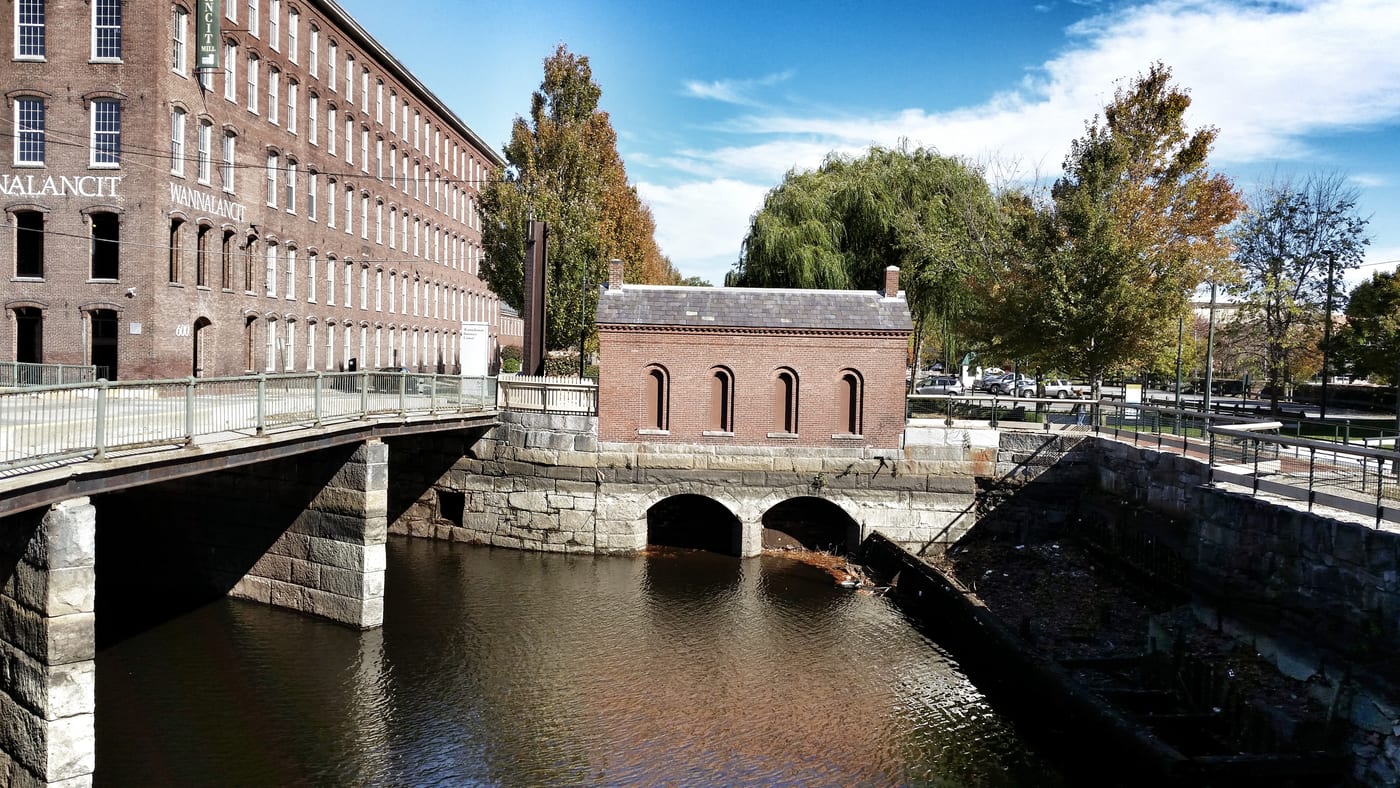
Lowell: a city built around the mills
Lowell was, in the words of the National Park Service, "the first large, planned, industrial city in America." Boston investors laid it out beginning in 1821 at the Pawtucket Falls on the Merrimack River, where the drop in the water could be turned into power for textile machinery.
Between roughly 1822 and 1848 the company built a dam at the head of the falls, seven power canals, and more than fifty mill buildings across some ten large firms. The canals were not scenery; they were the machine that moved water through the mills. The Boott Cotton Mills, built from the 1830s onward, survive as one of the more architecturally significant mill complexes in the country, and the Boott Cotton Mills Museum within Lowell National Historical Park interprets that industrial history on site.
The early workforce was largely young New England women, the "mill girls" who lived in company boardinghouses and worked long days at the looms. Over the following decades that labor force changed completely, as Irish, French-Canadian, Greek, Polish, and Portuguese immigrants arrived for the jobs. Lowell grew from a few thousand people to more than thirty thousand. It was a model other New England mill towns copied, and it set the pattern for how American industry organized both water and people.
Lawrence and the Merrimack Valley mill towns
Lowell was the prototype, but it was not alone. Lawrence, founded downstream on the same river, became a concentrated textile center whose mills drew workers from across Europe and the Middle East. By the early twentieth century the city's mill labor force spoke dozens of languages, with most of the unskilled work done by recent immigrants.
That labor history is not only one of production but of conflict. In January 1912 a state-mandated cut in weekly hours came with a corresponding cut in pay, and Lawrence textile workers walked out in what became known as the Bread and Roses strike. The walkout grew to more than twenty thousand workers across the city's mills and united people of many nationalities. After roughly two months it ended with wage increases, and similar raises followed for hundreds of thousands of textile workers across New England.
The mill towns of central and western Massachusetts, including Worcester and Springfield, were part of the same industrial economy, supplying machinery, tools, and skilled trades. Worcester in particular grew as a manufacturing and engineering center, the kind of place where the region's industrial knowledge was applied beyond textiles.
New Bedford: the whaling coast and the road to freedom
On the south coast, New Bedford built its wealth on whaling. The National Park Service describes it as the heart of the nineteenth-century whaling industry and notes that it is "famously known as the 'City that Lit the World,'" a reference to the whale oil that lit lamps far beyond Massachusetts. New Bedford Whaling National Historical Park preserves the downtown district tied to that trade.
The whaling economy created shoreside and seagoing jobs for people of many backgrounds, and that openness, combined with a large Quaker population and a community of free Black residents, made New Bedford a destination on the Underground Railroad. By the 1840s the city sheltered several hundred people who had escaped slavery.
Frederick Douglass came to New Bedford in 1838 after escaping slavery. Nathan and Polly Johnson, a Black couple active in the Underground Railroad, gave Douglass and his wife Anna their first free home, and it was Nathan Johnson who suggested the surname "Douglass." The Nathan and Polly Johnson House was designated a National Historic Landmark in 2000 and added to the National Park Service Underground Railroad Network to Freedom in 2001.
Springfield: the armory and the inland industrial economy
Springfield, at the meeting of the Connecticut River and major inland roads, became an industrial center of a different kind. Its arsenal dates to the Revolutionary War, when the site was established to support the war effort, and it went on to become the first national armory of the United States, beginning musket manufacture in 1794.
The armory operated for nearly two centuries, until 1968, producing firearms used by American forces across the nation's wars. In doing so it developed manufacturing methods, including interchangeable parts and precision production, that influenced American industry well beyond weapons. The Springfield Armory National Historic Site preserves the grounds and what the National Park Service calls the world's largest historic United States military small-arms collection.
The armory anchored a wider manufacturing economy in the Connecticut River Valley, and Springfield remains a hub for visitors exploring that history alongside the city's museums and the surrounding central Massachusetts region.
Immigrant neighborhoods and the cost of the work
The industrial economy reshaped Massachusetts cities into immigrant places. Boston's North End, the city's oldest residential neighborhood, shifted from a colonial enclave to an Irish and then Jewish district before becoming overwhelmingly Italian-American by the early twentieth century, when immigrants and their children made up the great majority of its residents. Similar transformations played out in the mill cities, where ethnic neighborhoods grew up around the factories.
It is worth being plain about what the work cost. Mill and factory labor meant long hours, low pay, child labor, and dangerous conditions, and the Lawrence strike was a direct response to those terms. The whaling fortunes of New Bedford were built on grueling and dangerous voyages, and the same port stood, at times, against the slavery that the wider national economy depended on.
For a traveler, these sites read best together. Lowell and New Bedford explain how the work was organized; Lawrence explains what the workers did about it; Springfield and the inland cities show how the skills spread. The National Park Service units make the physical evidence, the mills, canals, waterfront, and armory grounds, accessible on the ground.
Sources
Reviewed source trail
- Lowell National Historical Park — Building America's Industrial Revolution: The Boott Cotton Mills (NPS) — checked 2026-06-22
- Lowell National Historical Park (NPS) — checked 2026-06-22
- New Bedford Whaling National Historical Park — History & Culture (NPS) — checked 2026-06-22
- Nathan and Polly Johnson House (NPS) — checked 2026-06-22
- Springfield Armory National Historic Site — History & Culture (NPS) — checked 2026-06-22
- Bread and Roses Strike of 1912, Lawrence, Massachusetts (Digital Public Library of America) — checked 2026-06-22