City guide · Central Massachusetts
Worcester: the heart of the Commonwealth, where work became knowledge
Worcester is the second-largest city in Massachusetts and the seat of Worcester County, sitting at the geographic center of the Commonwealth. Its story runs from Nipmuc land around Lake Quinsigamond, through a nineteenth-century industrial boom built on the Blackstone Canal and the railroad, to a present-day economy anchored by universities, museums, and the immigrant neighborhoods whose people have always shaped its work and its character. This guide traces five threads: the old public city, the industrial and reform city, the city of knowledge and art, the city of everyday culture, and the green city.
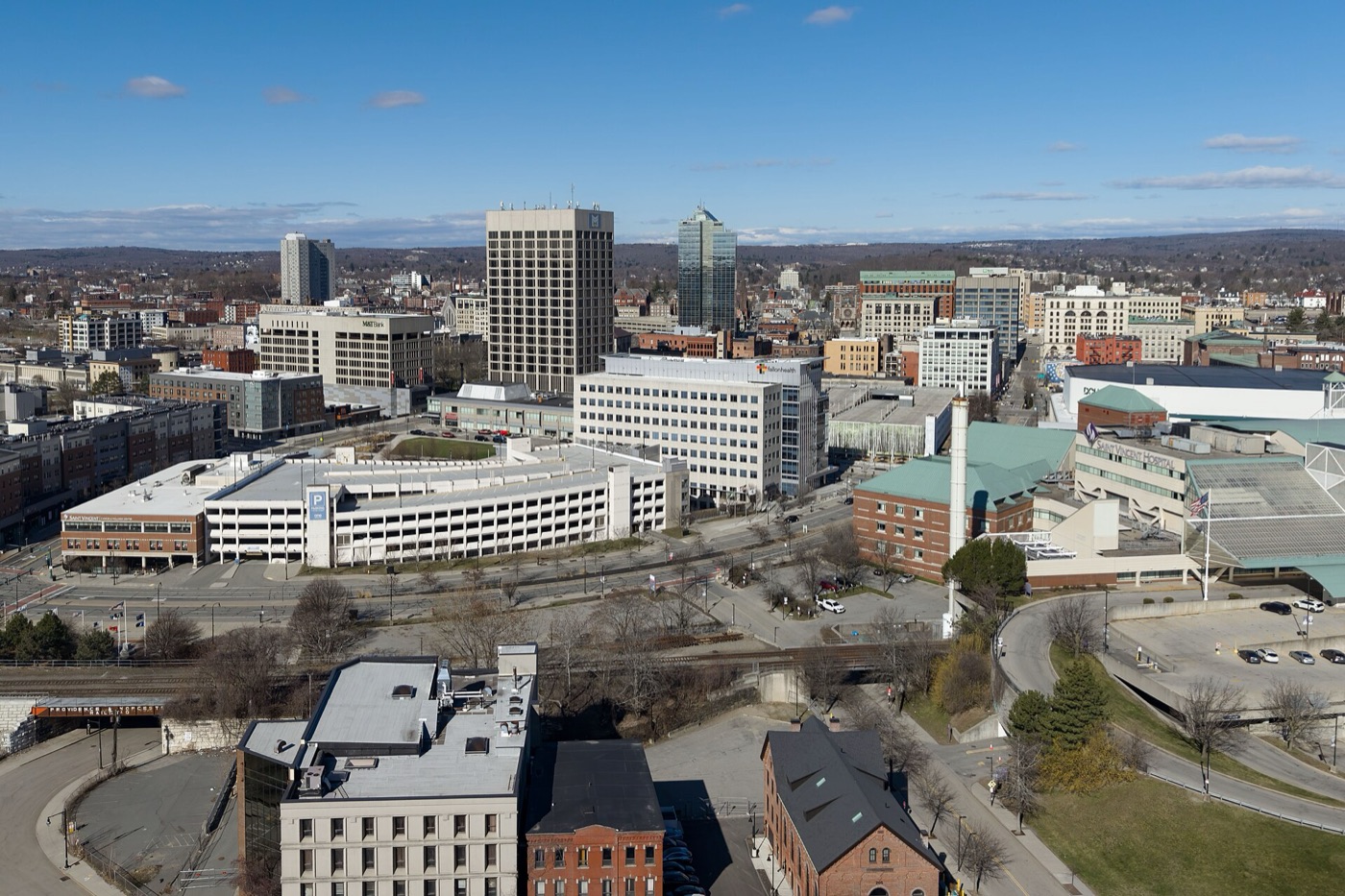
The old public city
Before it was Worcester, the land around the lake now called Lake Quinsigamond was Nipmuc country. Quinsigamond was a Nipmuc village in what is now central Massachusetts, and the name attached first to the lake and then to the early colonial settlement. English attempts to settle the area were abandoned during King Philip's War in 1675; permanent resettlement did not hold until the early eighteenth century.
Worcester was incorporated as a town on June 14, 1722, and as a city on February 29, 1848. Its civic heart is Worcester Common, the old town common that anchors downtown, with City Hall facing it. The city's deep history is legible in surviving buildings: the Salisbury Mansion, a Georgian house built in 1772 as the home and store of the merchant Stephen Salisbury, is the only home in Worcester open to the public that is furnished to interpret a specific local family. It was moved from Lincoln Square in 1929 to its present site.
Worcester's rise as a transportation hub is captured by Union Station, which opened on June 4, 1911 in a French Renaissance Revival design by Watson & Huckel, built to serve a city that was then one of the largest in New England. The station fell into disuse and was abandoned as a rail hub in 1972, then restored around 2000 alongside the return of commuter rail to Boston, a small mirror of the city's larger arc of decline and recovery.
The industrial and reform city
Worcester sits inland, away from the ocean and the river mouths that powered the first New England mill towns, so its industrial age arrived by canal and rail. The Blackstone Canal opened in 1828, linking Worcester to Providence and tidewater along the Blackstone River valley. It was soon overtaken by the Boston and Worcester Railroad, which opened on July 4, 1835 and gave the city a direct line to Boston. Together they turned a county seat into a manufacturing center.
What Worcester made was metal and the machines that worked it. Ichabod Washburn's wire works grew into one of the country's largest wire manufacturers; the city also became known for machine tools and for abrasives, with the Norton Company founded in Worcester in 1885. Industry clustered in districts such as Quinsigamond Village in the south of the city. The workforce was housed in three-deckers, the stacked three-family wooden houses that are closely associated with Worcester and that still define many of its neighborhoods.
Industry and reform grew side by side. The first National Woman's Rights Convention was held in Worcester on October 23 and 24, 1850, drawing roughly a thousand people to Brinley Hall, with figures including Lucy Stone, Abby Kelley Foster, and Frederick Douglass taking part. A few years later the city's workers built a monument to their own ambitions: Mechanics Hall, raised by the Worcester County Mechanics Association (formed in 1842) and dedicated on March 19, 1857. It remains one of the finest surviving pre-Civil War concert halls in the country.
The city of knowledge and art
Worcester's reputation for learning predates its factories. The American Antiquarian Society was founded in 1812 on the initiative of the patriot printer Isaiah Thomas, who chose inland Worcester partly because it was thought safe from British warships during the War of 1812. It was the first historical society in the United States national in scope, and Thomas seeded it with thousands of volumes from his own library; today it is among the foremost research libraries of early American history and culture.
The arts followed. The Worcester Art Museum was founded in 1896 by Stephen Salisbury III and a circle of supporters and opened to the public in 1898, building a collection that now spans fifty centuries. The museum sits within a dense academic landscape: the College of the Holy Cross (1843), the oldest Roman Catholic college in New England; Worcester Polytechnic Institute, founded in 1865 (as the Worcester County Free Institute of Industrial Science); and Clark University, chartered in 1887 and opened in 1889 as an early American center for graduate study.
Clark also links Worcester to the space age. Robert H. Goddard, a Clark physics professor, launched the world's first liquid-fueled rocket on March 16, 1926 from a farm in nearby Auburn. The flight lasted about two and a half seconds and rose some 41 feet, witnessed by only a handful of people, but it pointed directly toward modern rocketry. The city's appetite for hands-on science is older still: the EcoTarium, New England's leading science and nature museum, traces its roots to 1825 and the Worcester Lyceum of Natural History.
The city of everyday culture
Worcester has an outsized record in the small inventions of everyday American life. Esther Howland, a Worcester native, began producing elaborate Valentine cards from her family home in the late 1840s and built one of the first commercial Valentine businesses in the country, helping turn the holiday into a mass-market tradition.
More than a century later the city produced another piece of pop iconography. In 1963 the Worcester commercial artist Harvey Ball was paid forty-five dollars by a local insurance company to design a morale-boosting graphic, and in a few minutes he drew the yellow smiley face. Neither he nor the company copyrighted it, and it went on to circle the globe.
Two more Worcester contributions are felt in kitchens and bowling alleys across New England. Candlepin bowling, played with slim cylindrical pins and a small handheld ball, was devised in Worcester in 1880 by Justin White; the game remains a regional institution. And the Worcester Lunch Car Company built prefabricated diners here from 1906 to 1957, shipping hundreds of them across the Northeast and helping make the diner a fixture of American roadside life. That everyday culture is still nourished by the cuisines of the city's immigrant communities, and downtown the restored Hanover Theatre, housed in a 1904 building reopened as a performing arts center in 2008, gives the city a grand stage.
The green city
For a city built on metalworking, Worcester invested early in open space. The land for Elm Park was purchased in 1854, one of the earliest instances in the United States of a municipality spending public money to buy land expressly for a public park. Newton Hill was added across Park Avenue in 1888, expanding the grounds into the rolling, tree-lined landscape walkers know today.
Worcester's largest park is Green Hill Park, more than 480 acres of woods, ponds, and fields on the city's east side. To the east the land falls toward Lake Quinsigamond, the long, narrow lake that gives its name to Quinsigamond State Park, where Regatta Point and Lake Park draw rowers, swimmers, and picnickers to the same water the Nipmuc once fished.
Running through it all is the Blackstone River, the working river that powered the valley's mills and once carried the canal. Worcester sits near its headwaters, and the river ties the city into the wider Blackstone River Valley, a corridor now recognized for its industrial heritage. Together the parks, the lake, and the river show a second face of the manufacturing city, one that bought green space for its workers as deliberately as it built halls and factories.
Places worth a stop
Where to go in Worcester
Sources
Reviewed source trail
- Worcester, Massachusetts — Wikipedia (incorporation dates, Nipmuc/Quinsigamond, industry, three-deckers) — checked 2026-06-22
- Mechanics Hall — History (formed 1842, dedicated March 19, 1857) — checked 2026-06-22
- Mass Moments — First National Woman's Rights Convention, Worcester 1850 (Brinley Hall) — checked 2026-06-22
- American Antiquarian Society — About (founded 1812, Isaiah Thomas) — checked 2026-06-22
- NASA — 95 Years Ago: Goddard's First Liquid-Fueled Rocket (Auburn, March 16, 1926) — checked 2026-06-22
- EcoTarium — About Us (roots 1825, Worcester Lyceum of Natural History) — checked 2026-06-22
- Elm Park (Worcester) — Wikipedia (land purchased 1854; early US public park) — checked 2026-06-22