City guide · Merrimack Valley
Lowell: where water became the machine and labor became memory
Lowell, Massachusetts, on the Merrimack in the Merrimack Valley, is widely called the cradle of the American Industrial Revolution: a planned mill city built in the 1820s on the water power of Pawtucket Falls. This guide traces its arc with both pride and honesty — the canals and the looms, the young women and waves of immigrants who ran them, the hard labor and deindustrialization that followed, and the post-industrial reinvention through historic preservation, a national park, art, literature, and a riverside landscape.
Water and the machine
Before the mills, Pawtucket Falls on the Merrimack River was a fishing ground. The falls and the rapids below them drop roughly 32 feet, and for generations the Indigenous Pawtucket people and the wider Pennacook world gathered here for the seasonal runs of migratory fish, including salmon, using weirs and nets at one of the richest sites on the river. The Algonquian name Pawtucket means, in effect, 'at the falls in the river.' The river that would later turn the wheels of industry was first a place of subsistence and trade.
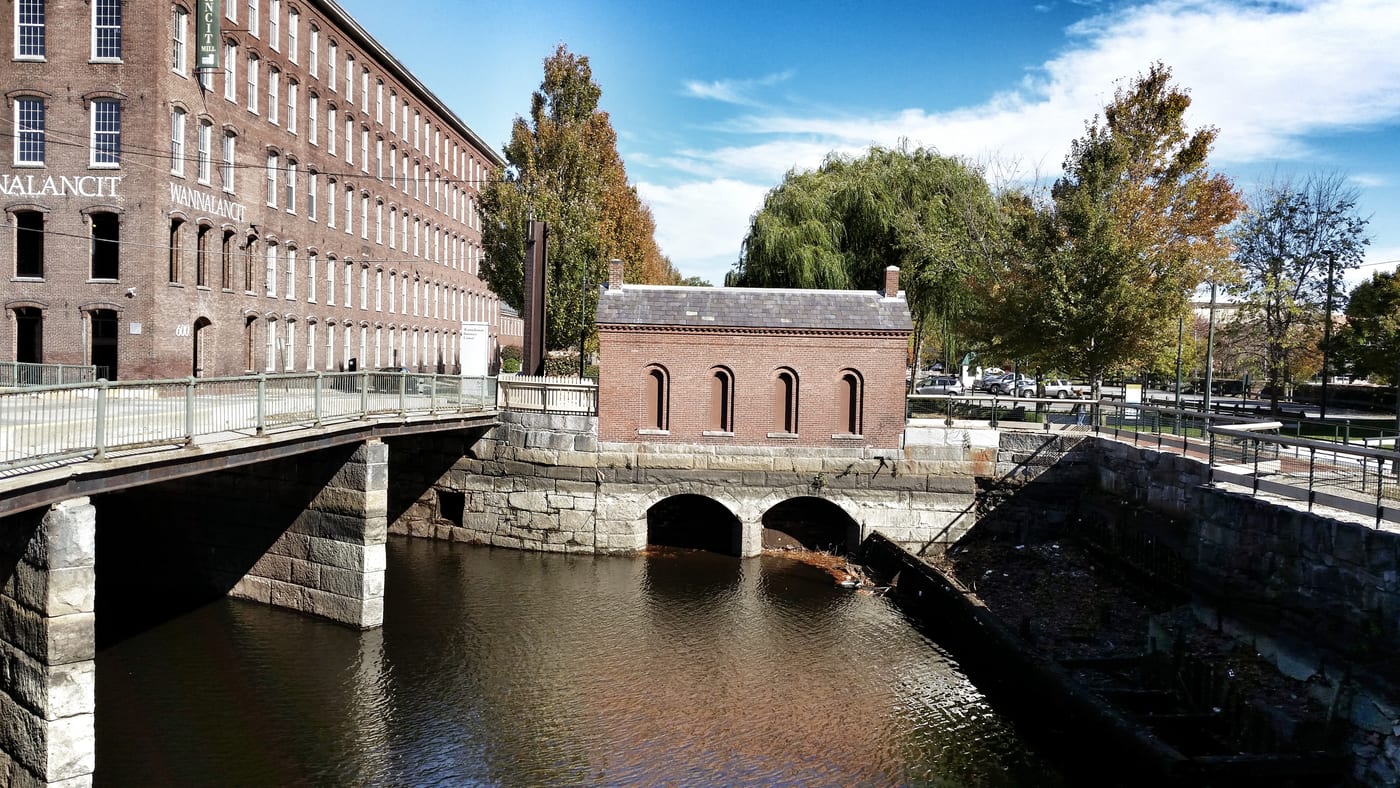
In the early 1820s a group of Boston merchants and investors, the Boston Associates, looked at that same drop in the river and saw kinetic energy. They bought up the old Pawtucket Canal in what was then East Chelmsford and incorporated the Merrimack Manufacturing Company in 1822, naming their new town for the recently deceased Francis Cabot Lowell. The feeder canal that had been dug to move boats around the falls was reengineered to move water to mill wheels instead.
From that beginning grew a roughly 5.6-mile system of power canals, often described as the largest such system in the United States, fanning out from the falls to drive the waterwheels and later turbines of mill after mill. The company that managed the water and the land, the Proprietors of Locks and Canals, effectively engineered the city. Today the heart of that system survives as the Locks and Canals Historic District, listed on the National Register in 1976 and designated a National Historic Landmark in 1977 — recognition that the canals themselves, not just the buildings they powered, are the artifact.
The mills and the workers
Lowell is commonly identified as the first large planned industrial city in the United States: not a settlement that drifted into manufacturing, but a city laid out deliberately around water power, with mills, boarding houses, and canals designed as a single system. That ambition is now preserved as Lowell National Historical Park, established by Congress in 1978 as an urban national park — a park whose subject is labor and industry rather than wilderness.
At the Boott Cotton Mills Museum, visitors can stand in a recreated 1920s weave room where over 80 power looms run at once. The Draper looms were built in the early twentieth century and acquired by the Park Service, and when they are running the noise is the point: it conveys, more honestly than any label, what a working life on the floor sounded like. Nearby, the Patrick J. Mogan Cultural Center — itself a former corporation boarding house — houses an 'Inside an 1840s Boarding House' exhibit that reconstructs the cramped, regulated domestic world the mill workers went home to.
The early workforce was famously made up of the 'mill girls,' young, mostly single women recruited from New England farms to live in supervised boarding houses and tend the machines. The promise was real — wages, independence, a magazine and a literary life of their own — but so was the cost. Days ran twelve to fourteen hours in hot, lint-filled, deafening rooms. When owners cut pay and sped up the work in the 1830s and 1840s, the women organized, struck, and petitioned, in some of the earliest industrial labor protests in the country. Many left, and the work passed to the immigrants arriving in greater numbers.
The immigrant city
Lowell was built on imported labor, and its population reads as a sequence of arrivals. Irish workers dug and then worked the canals and mills from the start; French-Canadians came down from Quebec in large numbers; then Greeks, Portuguese, Poles, Russian Jews, and Armenians, each filling tenement neighborhoods and the lower-paid jobs the previous group climbed out of. The mills ran on long hours, low wages, and crowded housing — the hard underside of the city's prosperity.
Those arrivals settled into districts that still carry their histories: The Acre, long an immigrant gateway, first Irish and Greek; Pawtucketville above the falls; Belvidere on the higher ground east of the Concord River; and Centralville across the Merrimack. The neighborhood names are a map of who came and where they could afford to live.
In the late twentieth century a newer wave reshaped the city again. After the Khmer Rouge genocide and the upheaval that followed in the late 1970s and 1980s, Cambodian refugees resettled in Lowell in large numbers, and the city became home to one of the largest Cambodian American communities in the United States — second, by common reckoning, only to Long Beach, California. The district now known as Cambodia Town, with its temples, markets, and restaurants, is the most visible chapter in Lowell's continuing identity as an immigrant city, carrying both the trauma that drove the migration and the community rebuilt afterward.
Art, memory, and literature
Lowell's cultural memory is unusually dense for a city its size. The Whistler House Museum of Art occupies the house, built around 1825 by the Locks and Canals company, where the painter James McNeill Whistler was born in 1834; it is now run by the Lowell Art Association, one of the oldest art associations in the country. A short walk away, the New England Quilt Museum preserves textile art in a fitting setting — a Greek Revival building of 1845 that was originally a savings institution, in a city whose fortune was made in cloth.
The Lowell Cemetery, dedicated in 1841, belongs to the era's rural, or garden, cemetery movement that began at Mount Auburn near Boston: a landscaped burial ground meant also as a place to walk and reflect, at a time when the industrial city had almost no parks. It is one of the early examples of the form in the country.
Lowell is also Jack Kerouac's city. The novelist was born here in 1922 to French-Canadian parents, and the mills, the river, and the immigrant streets run through his autobiographical fiction. The Jack Kerouac Commemorative, a small park of inscribed granite columns conceived in the 1980s, sets passages from his books in stone near the canals he wrote about. The city's performing-arts life continues at the Merrimack Repertory Theatre and the grand Lowell Memorial Auditorium, keeping the cultural thread active rather than purely historical.
The post-industrial city and its nature
The textile industry that built Lowell largely left it, drifting south and then overseas across the twentieth century, and the city lived through the hollowing-out that follows deindustrialization. The unusual response, beginning in the 1970s, was to treat the abandoned industrial fabric as heritage worth saving rather than blight worth clearing. Massachusetts created Lowell Heritage State Park in 1974, and a coalition led by Lowell native Paul Tsongas, then a U.S. Representative, carried the idea to Washington, where Congress established Lowell National Historical Park in 1978. The model — preserving working-class and industrial history, not just grand architecture — has since been studied by other cities.
Higher education anchored the reinvention too. The University of Massachusetts Lowell traces its roots to two late-nineteenth-century institutions: the Lowell Normal School, chartered in 1894 to train teachers, and the Lowell Textile School, founded in 1895 to train technicians and managers for the mills. Their successors merged into the University of Lowell in 1975 and joined the University of Massachusetts system in 1991, turning a textile city into a research-and-engineering one.
What remains is a city you can read on foot. The canal walkways and the Merrimack riverwalk follow the same water that ran the looms; the Lowell-Dracut-Tyngsborough State Forest offers woods at the edge of town. Each summer the Lowell Folk Festival fills the downtown with free music, dance, craft, and food — by common description the second longest-running and second-largest free folk festival in the United States, after Seattle's Northwest Folklife. It is a fitting close to the city's arc: a place that turned water into a machine, ran on the labor of women and immigrants, paid the price of that industry, and then chose to remember the whole of it.
Places worth a stop
Where to go in Lowell
Sources
Reviewed source trail
- Lowell National Historical Park (U.S. National Park Service) — checked 2026-06-22
- Massachusetts: Lowell National Historical Park — NPS feature article — checked 2026-06-22
- The Boott Mills Weave Room — Lowell NHP (NPS) — checked 2026-06-22
- Locks and Canals Historic District — City of Lowell, MA — checked 2026-06-22
- Whistler House Museum of Art — About / Lowell Art Association — checked 2026-06-22
- The Museum — New England Quilt Museum — checked 2026-06-22
- Lowell Folk Festival — Wikipedia (festival ranking and history) — checked 2026-06-22