City guide · Pioneer Valley
Easthampton: water, mills, and the creative revival
A small western Massachusetts town in the Pioneer Valley that turned its 19th-century button and textile mills into artist studios — and kept its water, its rail trail, and Mount Tom on the horizon at the center of public life. It works best as a thematic stop near Northampton and Amherst rather than a first New England priority, but on its own terms it is a complete small place.
The valley before the town
Long before the mills, this stretch of the Connecticut River valley was the homeland of the Nonotuck (also written Norwottuck), whose territory ran along both banks of the river they knew as Kwinitekw and reached into what are now Northampton, Hadley, Hatfield, Amherst, and Easthampton. Reading the town only as an English mill settlement misses the older river-and-forest world it was built on.
English settlement here began at Pascommuck, an early outlying community attached to the Northampton grant from the 1660s. In 1704, during Queen Anne's War, Pascommuck was attacked by a French-allied raiding party and most of its small settlement killed or carried off — part of the wider colonial frontier violence between Native nations, English colonists, and their French rivals that ran through the valley, not a one-sided event. The dead were buried at what is remembered as the town's first burial ground.
Easthampton was set off as a separate district in 1785 and incorporated as a town in 1809. Its name simply marks its position east of the Northampton meadows; it is written as one word, Easthampton, and is a different place from East Hampton in Connecticut or on Long Island.
Water, buttons, and the mills
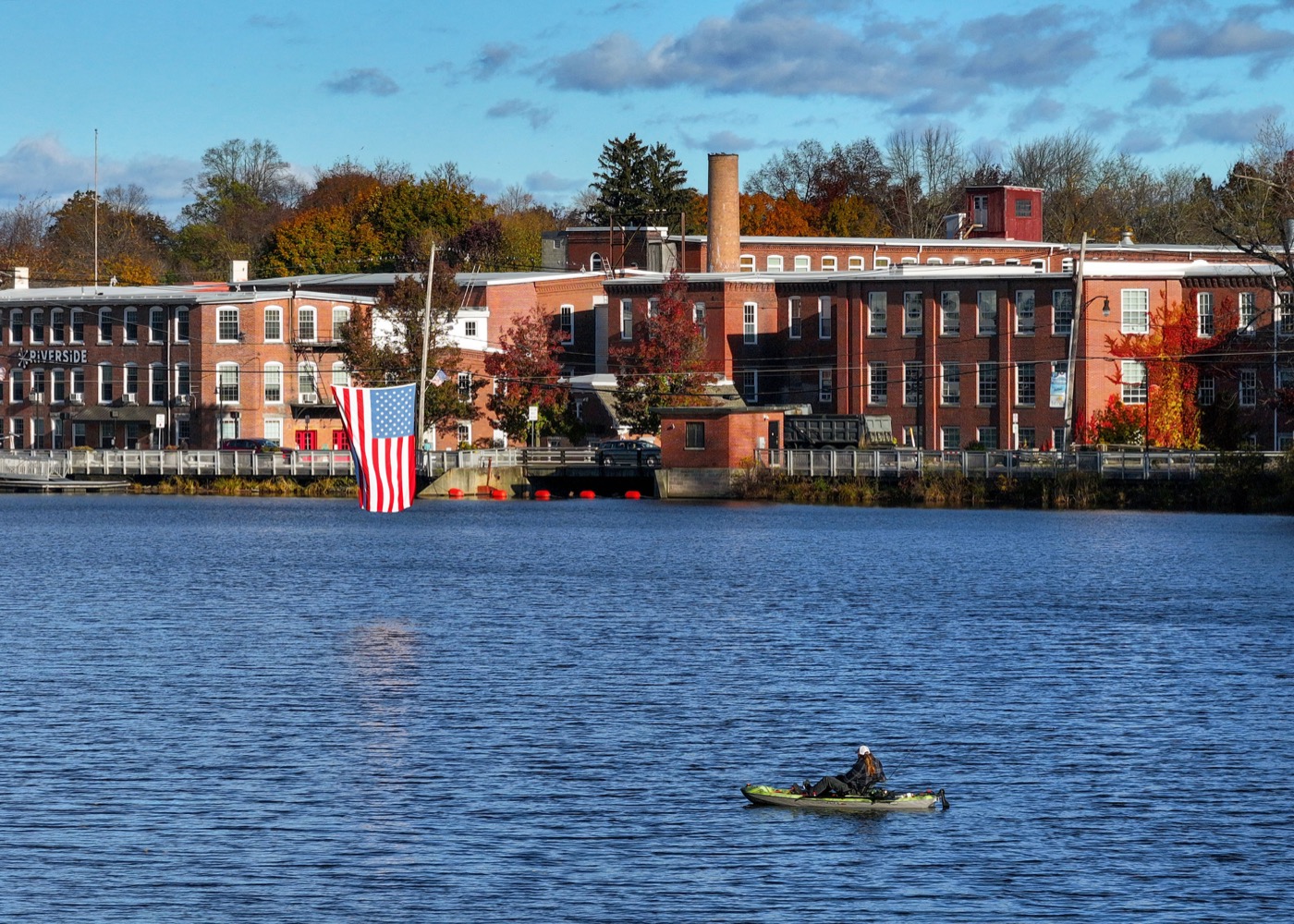
Easthampton's modern shape was set by water. The Manhan River and a system of dams and ponds gave the town the power to move from farming to manufacturing, and its 19th-century industry came to center on buttons, rubber goods, and textiles. The figure at the heart of that shift was Samuel Williston, a button manufacturer and philanthropist whose companies drove the town's growth.
The clearest mark of that era is Nashawannuck Pond, which sits in the middle of downtown today but was created in 1847 by the Williston–Knight Button Company to give the mills a steady water supply; it took its name from Williston's Nashawannuck Manufacturing Company. The pond is a small lesson in how the town worked: water became power, power became factories, and the factory water later became public space.
The mills also built the neighborhoods around them. New City, east of the Lower Mill Pond, was put up by the W. Boylston Mills to house workers and holds some of the town's oldest streets and infrastructure — a reminder that an industrial town is made of housing and people, not only factories and civic buildings.
The public and educational town
Industry here came paired with public giving. The Public Library Association of Easthampton was incorporated in 1869 by Samuel Williston and other townspeople, and after the library outgrew the town hall, his widow Emily Williston funded a new building with a major gift. Designed by the Boston architects Peabody and Stearns, the Emily Williston Memorial Library opened to the public on February 23, 1881, and still serves the town from the end of Park Street as the Easthampton Public Library.
The same instinct shows in the town's schools. Williston Seminary was founded in 1841 and, through later mergers, became the Williston Northampton School, an independent day and boarding school that still gives Easthampton an educational identity. The lesson Easthampton keeps repeating is that its mill economy and its public institutions — library, schools, town hall — were built by the same hands.
The Old Town Hall, a 19th-century civic building, carried that public life for more than a century before its municipal role moved on. Rather than lose it, the town kept it in use as a cultural venue, a pattern that runs through the rest of Easthampton's recent history.
From mills to studios
By the late 20th century the old factory buildings had lost their original industrial work. Stanley Home Products, a major employer housed in the Eastworks mill, closed its operations there in 1996. But Easthampton did not tear its mills down. Beginning in 1997, the Eastworks building added live-work lofts on its upper floor and filled the rest with studios, offices, small businesses, and event space — the town's signature move of turning a factory into a place to make and work.
That conversion spread into a recognized cultural identity. One Cottage Street and the surrounding Cottage Street Cultural District became a cluster of studios and small creative businesses, and the town's arts agency, Easthampton City Arts, helped put a small post-industrial town on the regional map as an arts community. The old Town Hall, now run as the CitySpace arts center, anchors the downtown end of that same story.
It matters how this is framed: Easthampton is not a factory town in decline that happens to have some artists. It deliberately reused its industrial buildings, and the creative economy now living inside them is the direct successor to the mills that built them.
The Pioneer Valley outdoors
For a small town, Easthampton has an unusually full set of outdoor places, and they tie back to the same water and rail history. The downtown Nashawannuck and Lower Mill ponds give the center a waterfront, and the Manhan Rail Trail — about six paved miles on a former rail line — runs the length of the town and links north to the Northampton bikeway and south toward Southampton.
Above it all is the Mount Tom range. The Mount Tom State Reservation offers roughly 22 miles of trails on the ridge, and in 2022 Easthampton opened the Mt. Tom North Trailhead Park, a crushed-stone path with graded slopes and level rest areas leading to a restored meadow, built so the mountain is reachable for a wider range of visitors. The connecting ridge trails do not meet the same accessibility standards. On the Easthampton–Northampton line, Mass Audubon's Arcadia Wildlife Sanctuary spreads about four miles of trails through forest, meadow, and floodplain along the Connecticut River's oxbow.
These are not headline national parks; they are a working small town's everyday landscape, much of it protected by local groups like the Pascommuck Conservation Trust, founded in 1982. Seen together — pond, trail, mountain, sanctuary — they round out a place best understood by walking the water, riding the trail, and looking up at Mount Tom.
Places worth a stop
Where to go in Easthampton
Sources
Reviewed source trail
- City of Easthampton — official site — checked 2026-06-24
- History of the Library — Easthampton Public Library — checked 2026-09-11
- Eastworks — About Us — checked 2026-06-24
- CitySpace Arts Center at Old Town Hall — checked 2026-06-24
- Mt. Tom North Trailhead Park — City of Easthampton — checked 2026-09-11
- Mount Tom State Reservation — Mass.gov — checked 2026-06-24
- Arcadia Wildlife Sanctuary — Mass Audubon — checked 2026-06-24
- Nonotuck homelands — Historic Northampton — checked 2026-06-24