City guide · Pioneer Valley
Amherst: where poetry, the colleges, and the valley meet
Amherst, Massachusetts, sits in the Pioneer Valley of Hampshire County on land long held by the Norwottuck (Nonotuck) people. It is a college town shaped by Emily Dickinson, Amherst College, the University of Massachusetts, and the wider Five College community, with specialist museums and working valley farmland close at hand. This guide walks through its literary history, its colleges and collections, its specialist cultural institutions, and the river valley and hills that surround it, with every concrete fact checked against authoritative sources as of June 2026.
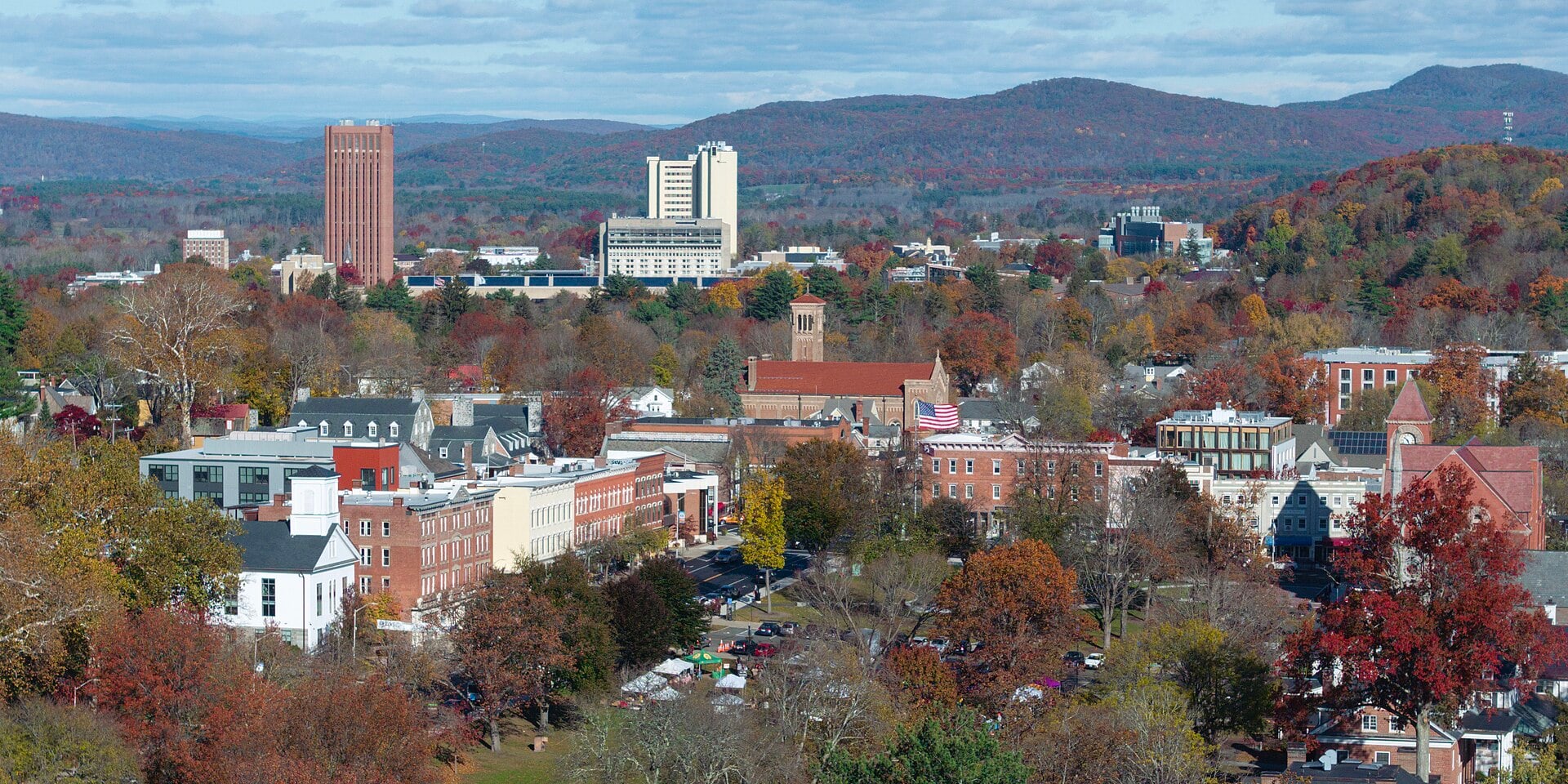
The literary and historic town
Long before it was a town, the land that is now Amherst belonged to the Norwottuck, also spelled Nonotuck, an Algonquian-speaking people of the mid-Connecticut River valley. Their homeland took in present-day Northampton, Easthampton, Hadley, South Hadley, Amherst, and Hatfield, and they were connected to neighboring nations sometimes grouped together as the Pocumtuc (Pocomtuc). They farmed corn, beans, and squash along the river they knew as Kwinitekw, and the valley's Indigenous history did not end with colonization; descendant communities maintained their identity through displacement and return.
The town's English name comes from Jeffery Amherst, a British commander in North America during the eighteenth century. That name is read critically today. During Pontiac's War in 1763, Amherst proposed deliberately spreading smallpox among Native peoples, writing of the idea in his own correspondence. Across North America, places named for him have been reconsidered; Montreal renamed its Amherst Street to Atateken Street in 2019. Naming the history plainly is part of describing the town honestly.
At the center of town is the common, the open green that organizes Amherst's civic life and around which much of its public life still turns. A short walk away, the Amherst History Museum occupies the Strong House at 67 Amity Street, built about 1744 by Nehemiah Strong only a few years after the formal settlement of Amherst began. It is one of the town's oldest surviving houses and a clear example of mid-eighteenth-century Connecticut River valley architecture; the Amherst Historical Society received it in 1916.
Emily Dickinson
Amherst is, for many readers, the town of Emily Dickinson. She was born at the family Homestead on December 10, 1830, and lived most of her life there. It was in that house that she composed the bulk of her work, close to 1,800 poems, the great majority of which went unpublished in her lifetime.
Today the Emily Dickinson Museum brings together two adjacent houses. The first is the Homestead itself, the brick house on Main Street where the poet was born and wrote. The second is The Evergreens, the Italianate house built in 1856 next door for her brother Austin and his wife, Susan Dickinson, on the occasion of their marriage.
The two houses, side by side, hold much of the texture of Dickinson's world: the family she lived among, the sister-in-law who was among her most important correspondents, and the rooms and grounds that bounded a life lived largely in one place. Visiting both is the closest thing to standing inside the geography of the poems.
The colleges and museums
Amherst College was founded in 1821 and is among the oldest colleges in Massachusetts. Its earliest buildings went up across that first decade, and Johnson Chapel, the landmark at the heart of the original College Row, was dedicated on February 28, 1827. Two of the college's museums are open to the public free of charge: the Mead Art Museum, whose global collection holds more than 20,000 objects spanning thousands of years, and the Beneski Museum of Natural History, one of New England's larger natural history museums and home to what it describes as the most extensive collection of fossil dinosaur tracks in the world.
On the other side of town is the University of Massachusetts Amherst, founded in 1863 as the Massachusetts Agricultural College under the federal Morrill Act, which created the nation's land-grant colleges. It began on roughly 310 rural acres with a handful of buildings and faculty and a curriculum joining farming, science, and the liberal arts. Its W. E. B. Du Bois Library, named for the scholar and activist whose papers it holds, is often described as the tallest academic library in the world.
These two institutions anchor the Five College Consortium, which links Amherst College, UMass Amherst, Smith College, Mount Holyoke College, and Hampshire College, allowing students to cross-register and share resources across the valley. Hampshire College, the youngest of the five and founded in 1965 as an experimental institution, weathered a severe financial crisis in 2019. In April 2026, however, its board of trustees voted to close the college permanently after the fall 2026 semester; as of mid-2026 it remains in operation while it helps current students complete their degrees or transfer.
Specialist culture
Amherst's cultural life reaches well beyond the campuses into institutions with a single deep focus. The Eric Carle Museum of Picture Book Art, founded by Eric and Barbara Carle and opened in November 2002, is devoted to the art of the illustrated book, with galleries, an art studio, and a collection that treats picture-book illustration as a serious art form for readers of every age.
Nearby, the Yiddish Book Center is dedicated to Yiddish literature and culture. It was founded in 1980 by Aaron Lansky, then a graduate student who set out to rescue Yiddish books before they were lost, and grew into a major center for the language's literature, history, and translation. Both institutions sit on the Hampshire College campus, on land given over from old apple orchards.
Around these anchors runs the ordinary infrastructure of a reading town: independent bookshops, a steady calendar of author talks and lectures drawn from the colleges, and the kind of public intellectual life that a dense cluster of campuses tends to produce. It is a place where a book event on a weeknight is unremarkable.
The valley and its nature
Amherst sits in the Pioneer Valley, the broad lowland of the Connecticut River, and the valley's deep, fertile soils still support working farms. Farm stands sell the seasons in turn: apples and cider in autumn, maple in late winter, and in spring the local asparagus long known as Hadley grass, named for the neighboring town where it became a signature crop.
South of town rises the Mount Holyoke Range, an unusual east-west ridge protected within Mount Holyoke Range State Park, which covers roughly 3,000 acres along about seven miles of ridgeline. Its high point is Mount Norwottuck, at 1,106 feet, which carries the Indigenous name of the people whose homeland this was and looks out over Amherst and the surrounding towns.
For getting into that landscape, two paths stand out. The Norwottuck Rail Trail, an eleven-mile paved route on a former railroad line managed by the state, runs from Northampton through Hadley and Amherst to Belchertown and crosses the Connecticut River on an old rail bridge. For walkers, the Robert Frost Trail threads north-south through conservation lands and woods across the area. In autumn the valley and its hills turn over into the fall foliage that draws visitors across New England.
Places worth a stop
Where to go in Amherst
Sources
Reviewed source trail
- Amherst College Timeline (founding 1821; Johnson Chapel 1827) — checked 2026-06-22
- Emily Dickinson Museum — Childhood and Youth (b. 1830, Homestead, The Evergreens 1856) — checked 2026-06-22
- Mead Art Museum, Amherst College (collection over 20,000 objects) — checked 2026-06-22
- Beneski Museum of Natural History, Amherst College — checked 2026-06-22
- Hampshire College — Closure Information (board vote to close after fall 2026) — checked 2026-06-22
- Mount Holyoke Range State Park — Mass.gov (~3,000 acres; Mount Norwottuck) — checked 2026-06-22
- Norwottuck Branch Rail Trail (11 miles; Northampton–Hadley–Amherst–Belchertown) — checked 2026-06-22